Writer's Blog #9 - Satoru Gojo

Spoilers for season 2 and season 3.
Please comeback once you read about a certain fight.
I've been thinking a lot about Satoru Gojo. Lot of people have.
The idea of the strongest is immediately appealing to the part of ourselves that wants to be great, are great, or appreciate greatness as a concept.
In my life I've noticed that very few people heed that call - so counter-intuitively, great characters become mirrors for our insecurities - we project what we wish for ourselves, so hard, we fail to appreciate greatness.
We each see ourselves in one facet of a brilliant diamond, seeking that fire, without realizing how much a stone has to go through to not be just a stone.
Realizing that as untrue for myself, so I can realize greatness, has been a call I've worked on answering, and in 2023, I took a hard look at myself, and writing, for the first time.
That's when I realized while my mind, body, heart and soul were fertile in many ways, I was not humble enough to realize that such fertility is appropriate preparation for seeds. That, cultivation is still required.
All that work for 15 years - it was just enough to get started on cultivating writing at its highest level.
Even then I may not make it, in life, or in legacy - why should I, when everyone else is also struggling to live and last? I was arrogant to think that being a writer conferred on me a special status of "currently seeking greatness, please understand and don't kill me", which somehow enabled my life force.
This is what Satoru Gojo goes through during enlightenment. It's an awakening of pure vitality, where your actualization is met equally by reality itself; you know who you are, where you want to be, and why you're not there.
In his case, his helplessness was triggered by the death of a girl he couldn't protect, despite giving his best.
His own inadequacy made him skip the grieving process, and resulted in him both learning the source of negative energy, but also being able to reverse that, and heal himself.
Then, in addition to manifesting the positive version of his technique, he also combined the negative and positive to ascend to the highest level of the sutras his clan has.
Then he started learning from his mistakes, and coming up with techniques that would allow him to be even stronger. Plus, he could teleport.
That part of his life matched what I was going through then, and I could relate to the unnecessary drive of being better just for the sake of learning from past mistakes. I spent 2.5 years working hard on being a better version of myself, and acquiring skills, and my writing improved without writing all the time.
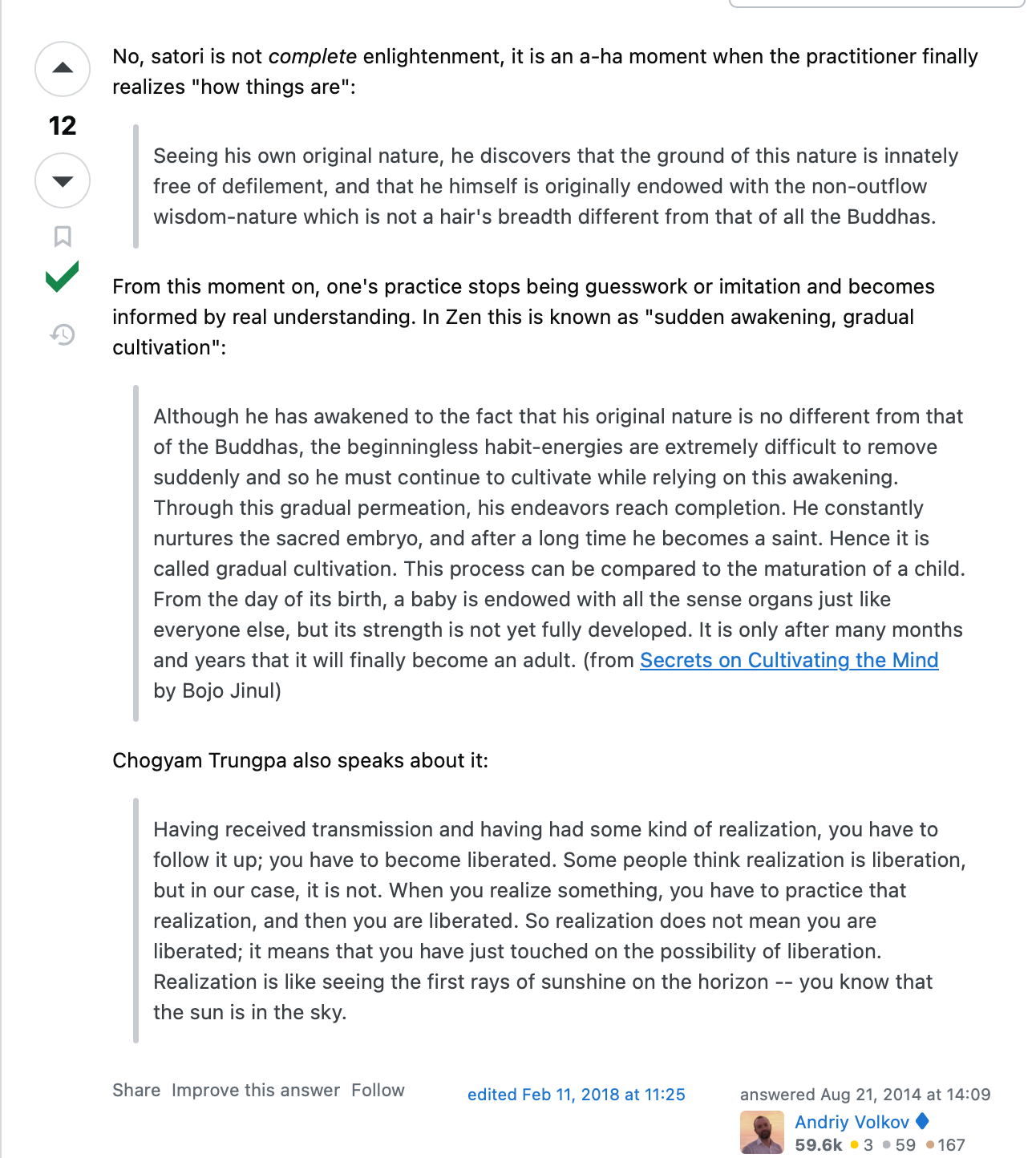
The problem is, neither Satoru nor I, were enlightened.
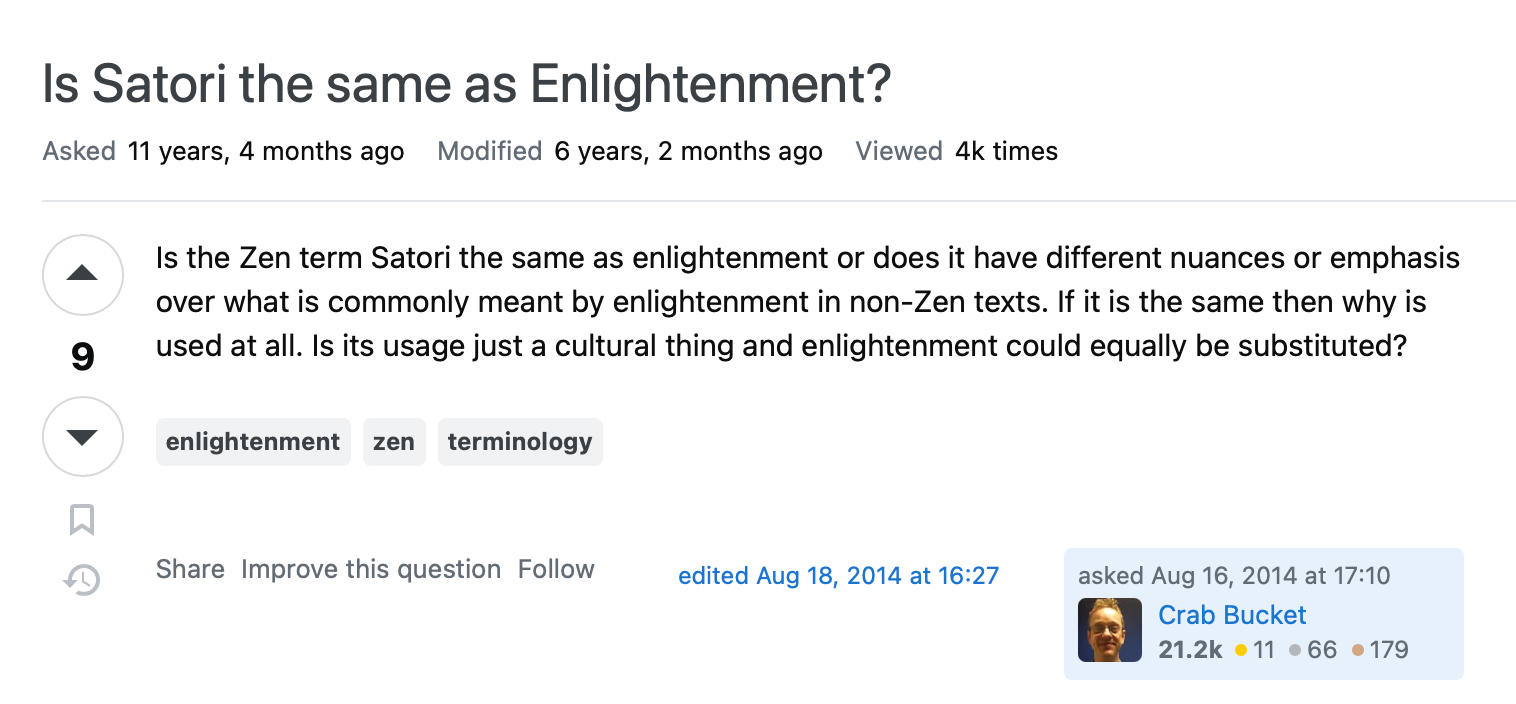
See Andriy's answer:
Enlightenment has its roots in the Dharma itself, and can manifest as being the world's greatest sorcerer, and the famous scene of literal transcendence:
"Among heaven and earth, I alone am the honored one" - Satoru Gojo, also Buddha.
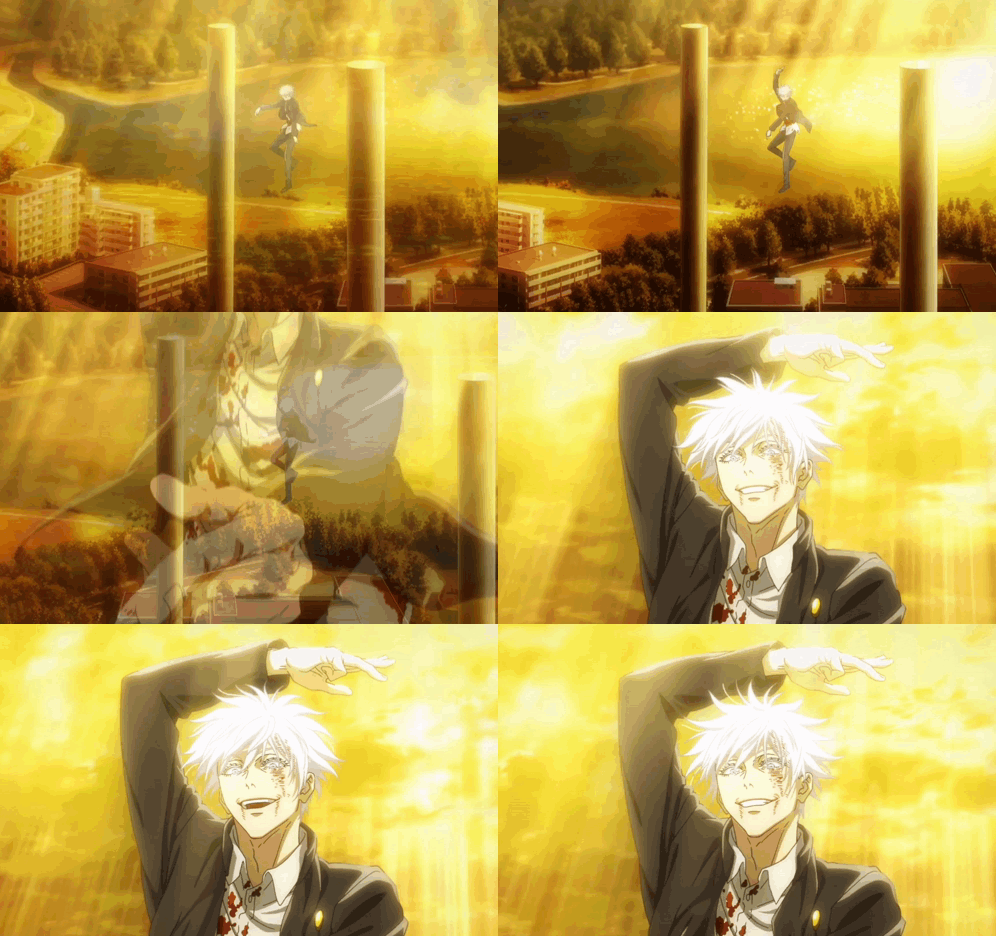
Never mind that someone who read Buddhist scripture should also know that Buddha was against magic, seeing it as an obstacle to enlightenment.
Or that Satoru had Sutras to learn from; or that his family was rich.
In other words, Satoru's failure in protecting a child, and transcendence, speaks to his talent, prodigious nature, hard work, and success.
Keeping in mind what we do know about him factually (his riches, upbringing, etc) it's like appreciating a person who is talented, passing an exam that most people can't.
Why won't a rich kid, who works hard, and is smart, pass an exam?
Sometimes I feel we ascribe positive qualities to celebrities like Bill Gates, Elon Musk, Sam Altman and Steve Jobs without truly understanding them, or that many normal people have great habits.
Last trip to India, I gave a servant a Rubik's cube to help her focus during break time.
I don't think she knew about it before; I just told her how to adjust the faces, and that the goal is to make the cube the same color on every side.
She very quickly figured out how to solve it; she got 2 sides looking correct.
After that, I stopped helping her, because that's how far I got, too. I never solved a cube correctly.
I believe many people will miss the limelight of greatness, simply because they don't care about it, and there's wisdom in such an approach.
In the same world, people less intelligent, but more fortunate, will have the resources they need to take care of their health, if not more.
Satoru loves being the center of attention, and has an unhealthy relationship with power.
The way he worked on his weaknesses after he almost died, reveals his tenacity and drive, but also a desire to be weak, spiritually, through magical avoidance.
Unlike characters from Jujutsu Kaisen who embraced their limits, or sought to surpass them healthily, Satoru's talent is a red herring - he is not the greatest.
He loves greatness.
So, unfortunately, his death now makes complete sense to me, against Sukuna. It is something I struggled to accept, but also understand.
Satoru Goju has attained Satori, is not enlightened, and moreover, neither fully manifest nor interested in spiritual transcendence. I think that's what Nanami points out to him, in the limbo after he dies.
Just like Toji lost to Satoru, in his arrogance, so did Satoru lose the duel, eventually - his greatness, not always earned (think of his riches, or access to Sutras that Geto didn't have) reveals a love of being great, not a spiritual triumph over the need to be great.
With God as his driver, Hanuman's flag, Drona's tutelage, and as a prince of Hastinapur, why won't Arjuna beat Karna?
While Arjun was able to accept winning Draupadi in exile, Karna could not accept the lack of privilege he was entitled to, as the forgotten first prince. He only focused on the rejection, everywhere he succeeded.
In other words, his anger found root in revenge - Kurukshetra really never was about loualty for him.
Karna hated that couldn't be what he could have been, and lost everything that he was.
Arjuna could never understand someone like Karna - being entitled, Krishna had to remind him of Karna's virtues - karuna.
In the end, Karna lost his life, Arjuna lost his son, and Ekalavya lost his thumb.
Sounds like the true winner is Ekalavya, who lost his thumb and focused on hunting even more.
The golden age ofjujutsuKurukshetra ended with talent killing talent, missing the entire point of dharma itself.
So even though the ability to do a Domain Expansion was rare, and indicative of actualization, I think the domain needs to be healthy in the Dharmic sense to indicate surprassing Buddha's 3 evils; ignorance, greed and hate.
Sukuna represents all 3, and he represents them better than Satoru. Not only does Satoru care, he also cares too much about winning.
Satoru was in self-denial, causing him to lose to Sukuna, just like Toji lost to him. Someone on the internet (I think it was reddit) pointed out that Satoru and Toji wore the same clothes when both died, which I didn't notice at first.
I think it's because Toji knew he would lose; he just didn't care, like he never did. He was a nihilist, despite unlocking a zen state of pure body-mind.
Satoru represents false enlightenment; seeking pleasure too much in wanting to win, despite unlocking teleportation.
Neither was following the middle way, through different ways.

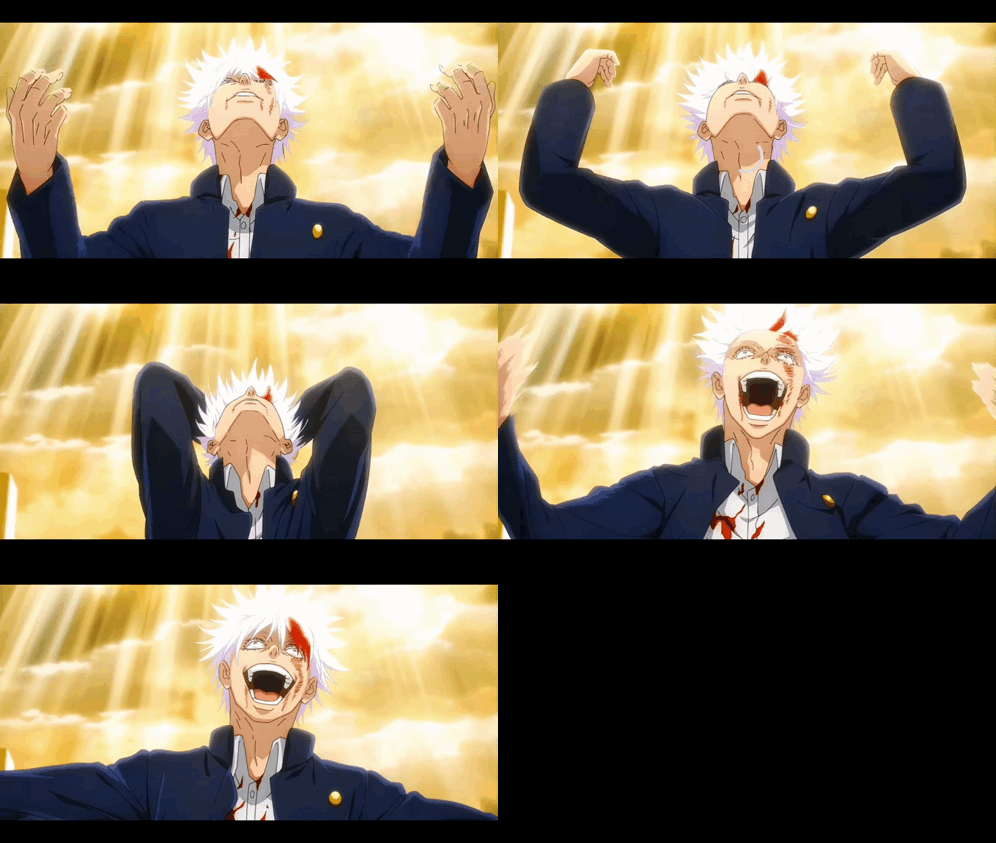
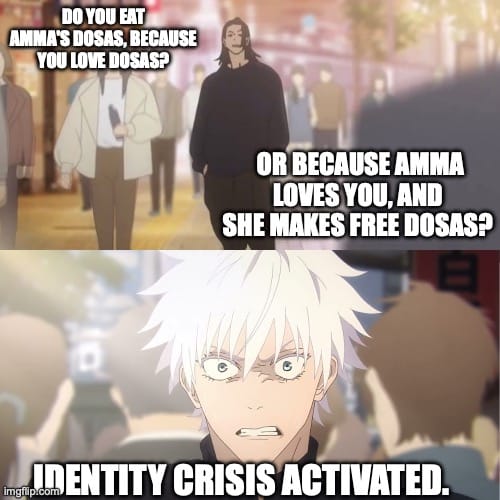
Satoru never transcended power - his need for it, his love of it, and the concept of power itself. I think that's what Suguru Geto meant when he asked his famous question:
"Are you great because you are Satoru Gojo, or are you Satoru Gojo because you are great?"
In all his talent, though he was only 16, he could only see that his best friend was leaving him.
Not the grief that was haunting his best friend.
Satoru then says you can't save people who are not ready to be saved - but in reality, Satoru was incapable of saving people without killing negativity, even if they want to be saved.
This is where Yuta and Yuji shine.
Yuta believes in compassion, very strongly. His domain expansion reflects that.

His abilities reflect a warrior's spirit, and a Buddha's kindness.
It's always a tragedy when someone dies - them being a demon or a hero has really nothing to do with suffering.

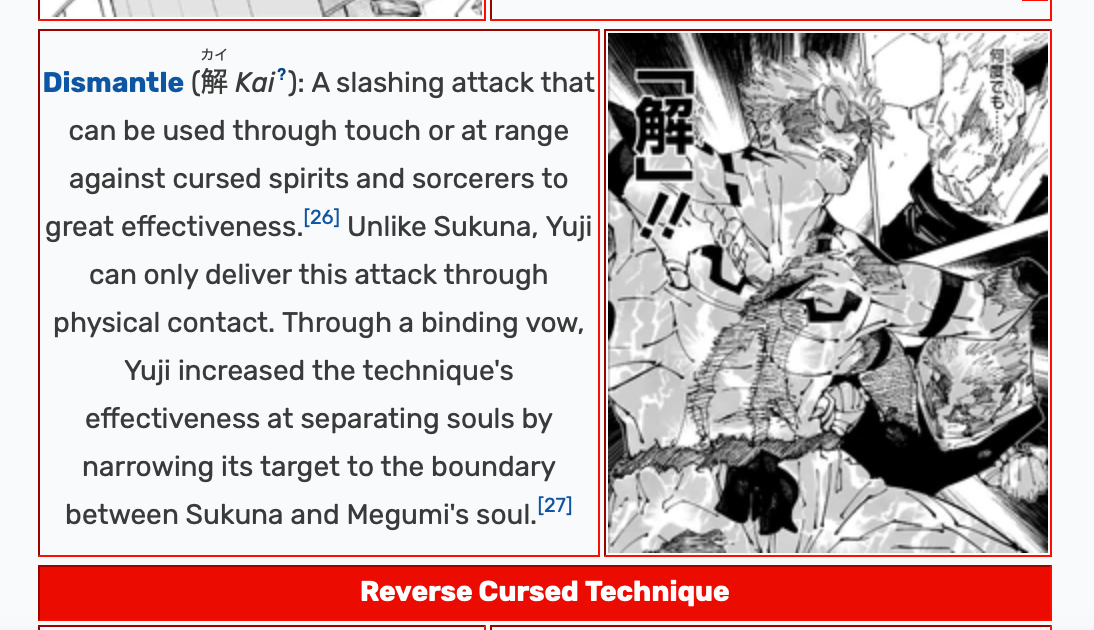
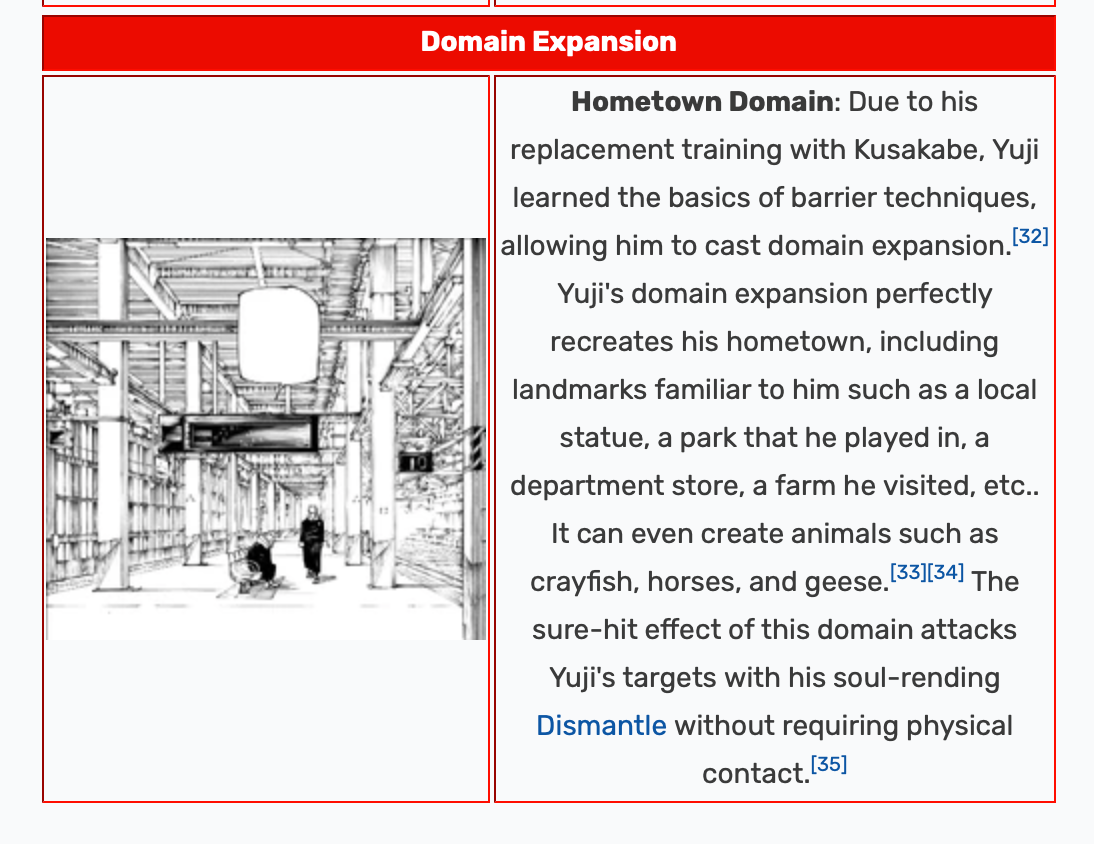
After winning his internal battle with Sukuna, Yuji absorbed Dismantle - but instead of destroying like the demon, Yuji's version separates negativity from the victim, representing a Boddhisatva theme common in anime.
Exorcise the sin, without killing the sinner.
Suffering in the normal world, like Yuta did, brought a sense of resilience in spirit that Satoru did not have. Satoru was happy to be the best, and was never interested in true enlightenment. He was interested in black flashes and Satori - a series of highs and flow states.
Yuji brought a level of compassion in wanting to save souls, that is a complete opposite of Satoru's dominating abilities.
Let's get back to me, for 2 minutes. Hang in there!

"Again, relatable. I spent 2.5 years working hard on being a better version of myself, and acquiring skills, and my writing improved without writing all the time."
- Suman Jampala, some JJK before.
I didn't go as far as Satoru did, and that's a good thing.
Even though my goal was to be the world's best writer, the arrogance doesn't arise from the goal itself, especially since I am capable of it.
Arrogance arises from being unable to accept that most things I care about, are not the end all be all, that my suffering is very common place, I don't get extra credit for suffering more, that I never considered the cost of this adventure, and that in the end, what I write is (hopefully) at best, going to sit on a shelf somewhere, several times, and be read by someone the way I intend it to be.
Yes, I may be eligible for the Nobel prize in literature. Anything is possible; I sure suffered as much as I could think of, to make sure I can be the best.
If that future comes to pass, that prize will sit on my mother's shelf, and then, one day, both metal and paper will become food for insects and the earth itself.
All the tears I cried will remain a souvenir, and prize or not, those tears too, will remain memories.

Moral of the story
True happiness comes from realizing one's insufficiency, without compromising one's potential at the same time as reality does it's best to be reality.
Sitting in that space is crucial - too much Satori is not Buddha's middle way. Too little, and you're subject to suffering.
Life is full of suffering is a feature of this simulation that needs to be accepted, and not a bug to be solved.
I am not being cool by writing my way out of suffering, through suffering, or under suffering.
It just looks cooler relative to what others did in my circle.
Member discussion